
 Add Reply

 Add Comment As A Guest
 Close Topic Options
Spanish Made Easy
Spanish Easy - Trinidad, Tobago / Caribbean - Posted: 2nd Mar, 2015 - 5:38pm
Posts: 13 - Views: 7008
 Learn Spanish Easily. Castellano, Spanish, Latin, Learn, Lessons, Tutor, Pictures, and Quiz.
Spanish Made Easy
Spanish Made Easy
This Thread used to be its own web site but we have since moved it here. Spanish Made Easy allows you to learn how to speak Spanish for FREE online through easy to understand lessons created by a Spanish teacher from Argentina. Allows you to learn how to speak Spanish for FREE online through easy to understand lessons created by a Spanish teacher from Argentina.
If you are ready to start just continue reading or if you will start later please be sure to Bookmark this page. You will notice that in some places I translated the text into Spanish so you can get an idea of how Spanish words are formed. These areas are in the form of quotes labeled: "Spanish Translation".
Welcome to Spanish Made Easy.
We hope you enjoy your visit and that we can help you in any concern you may have. The purpose of this Thread is to teach you Spanish and show you the difference it has with 'Castellano', a language that is used in some Latin-american countries. Here you'll find interesting lessons that will help you to study, practice and strengthen your confidence. If you talk Spanish already, you can expand your knowledge through learning how different some countries talk and that a same word has different meanings in each country. We will be glad to assist you anytime. We have tutorials online and we can even help you out with your homework!
Good luck in this new way to learn Spanish Made Easy in the World Wide Web.
 QUOTE (Spanish Translation)
Hola! Bienvenido a Espanol Hecho Fácil.
Esperamos que disfrute su visita y que podamos ayudarle en cualquier inquietud que Ud. Tenga. El propósito de este sitio es ensenarle Espanol y mostrarle la diferencia que tiene con el 'Castellano', lengua que se habla en algunos países de latino-america. Aquí encontrará lecciones interesantes que le ayudarán a estudiar, practicar y fortalecer su confianza. Si Ud. Ya habla espanol, puede expandir su conocimiento aprendiendo las diferencias de habla en algunos países y que una misma palabra tiene diferentes significados en cada país. Estaremos contentos de asistirlo en cualquier momento. Tenemos clases particulares en línea y hasta podemos ayudarle con su tarea!.
Buena suerte en esta nueva forma de aprender Espanol Hecho Fácil en el Extenso Mundo de la Web.
Esperamos que disfrute su visita y que podamos ayudarle en cualquier inquietud que Ud. Tenga. El propósito de este sitio es ensenarle Espanol y mostrarle la diferencia que tiene con el 'Castellano', lengua que se habla en algunos países de latino-america. Aquí encontrará lecciones interesantes que le ayudarán a estudiar, practicar y fortalecer su confianza. Si Ud. Ya habla espanol, puede expandir su conocimiento aprendiendo las diferencias de habla en algunos países y que una misma palabra tiene diferentes significados en cada país. Estaremos contentos de asistirlo en cualquier momento. Tenemos clases particulares en línea y hasta podemos ayudarle con su tarea!.
Buena suerte en esta nueva forma de aprender Espanol Hecho Fácil en el Extenso Mundo de la Web.
Spanish Made Easy (Hover)
Sponsored Links:
Easy Spanish
History of Spanish
Like anything else in the world, knowing the history of a language can give us a better perspective of how it evolved to become the way we speak it. There were many ancient languages such as; Greek, Latin, Egyptian and Hebrew. According to a book called, 'The Story of Language' by Mario Pei, it states; "Among all the world's languages, Greek and the Latin-Romance group are the ones of which we have the most complete unbroken history".
"Latin records run from c. 500 B.C. To the end of the Roman Empire and beyond, merging with nascent French in A.D. 842 and with nascent Spanish and Italian in 950 and 960, respectively." In my research I have discovered that of all the Romance Languages Spanish is the most widely spoken with Spain, almost all of South and Central America, Caribbean, Balearic and Canary Islands, Africa, U.S.A. There is also a variety of Spanish called, 'Ladino' (Spanish Jews who were expelled from Spain in 1492) spoken in Israel and Turkey.
As you will see in this course, Spanish varies in accent and slang widely from country to country, but the difference is not so great as to cause confusion. According to the book called, 'The Languages of The World' by Kenneth Katzner, "The purest form of Spanish is known as Castilian, originally one of the dialects that developed from Latin after the Roman conquest of Hispania in the 3rd century A.D."
There are English words that have developed from Spanish Origin, here are just a few; cargo, adobe, vanilla, tornado, embargo and bonanza. There are many words that you will find very familiar to English as you immerse yourself in study. Be sure to learn the pronunciation of each letter.
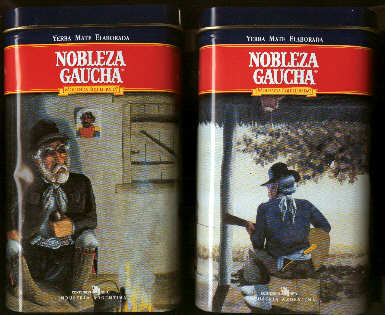
Image from personal files: Gaucha tins. These usually contain Yerba Mate, a herb that is drunk both hot and cold by the Gauchas and peoples of Argentina.
Spanish Made Easy (Hover)
Spanish Made Easy Caribbean / Tobago & Trinidad
Lesson One
The Spanish alphabet is very similar to English except for 'n'. Some years ago the alphabet also included as letters; 'll' and 'ch', but it is no longer the case.
I have pronounced each letter for you. Click each button below to hear the sound of that letter. Click on the button labelled 'ALL' to hear the whole alphabet. The format is .WAV so you will need a player that can play this file type.
You may wish to practice this over and over again. You may download the sound files to your own computer for later reference of personal use, but you may not distribute it or place it on your web site. Thanks.
Easy Spanish
An Expressive Language
The first thing you should learn about Spanish is that it is a very expressive language. You don't only use words to communicate with people but you use expressions in your face, hands and body. Some countries are more expressive than others, such is the case of Argentina, having a big population with a Italian background makes their expressions even stronger than other Latin-American countries.
If you're in a situation and you don't know how to say something, don't be afraid to use your hands to point to something or use other kinds of expression to show what you want to say. Spanish and Castellano are very similar languages, we are going to learn which are the most common differences and how to apply these differences in daily conversations.
1) What's your name? /Cuál es tu nombre?
2) How old are you?/ Cuántos anos tienes? (Espanol) Cuántos anos tenés? (Castellano)
3) What do you do?/A que te dedicas? (Espanol) A que te dedicás? (Castellano)
4) Where are you from?/De donder eres? (Espanol) De donde sos? (Castellano)
In these examples you can see that some letters has a little sign over them. This is called "Tilde or acento" And means that you have to give emphasis to that syllable.
Now, lets study the pronounces and see the differences:
| English I am You are He is She is It is You all are They are | Spanish Yo soy Tu eres El es Ella es Esto es Vosotros sois* Ellos son | Castellano Yo soy Vos sos El es Ella es Esto es Ustedes son Ellos son |
*Vosotros sois only is applied in Spain.
Note: Even if in some Latin-American countries the people speak Castellano, in the schools they teach the conjugations in Spanish but the people don't talk like that.
The big difference between Spanish and Castellano is that in Spanish we say "Tú" (You) but in Castellano we say "Vos" (You). Both of them has the same meaning but since they are different, the conjugation of verbs change too.
Example: Tú eres un maestro (Espanol) / Tú tienes 25 anos (Espanol)
Vos sos un maestro (Castellano) / Vos tenés 25 anos (Castellano)
If this is the first time you heard about Castellano then you probably think it is quite different to Spanish. It seems so but it's not. In a period of time you'll have to learn Spanish, you'll see how easy you can learn Castellano too. You'll talk two different languages and you will be able to communicate with anybody in any Spanish-speaking country.
Easy Spanish
Numbers In Spanish
Numbers are a very important part in the process of learning any language and one of the basic things you learn in Spanish.
One - uno
Two - dos
Three - tres
Four - cuatro
Five - cinco
Six - seis
Seven - siete
Eight - ocho
Nine - nueve
Ten - diez
Eleven - once
Twelve - doce
Thirteen - trece
Fourteen - catorce
Fifteen - quince
Sixteen - dieciséis
Seventeen - diecisiete
Eighteen - dieciocho
Nineteen - diecinueve
Twenty - veinte
Spanish Made Easy
Lesson Two
Now, in lesson 1 we learnt some basic Spanish; the alphabet, expressions, the prounouns, the verb 'To Be' and some differences between Spanish and Castellano.
In lesson 2, we are going to learn the verb 'to have', more basic expressions and the happy birthday theme song! The verb 'to have' has differences both in Spanish and castellano, see here:
| English I have You have He has She has We have They have You all have | Spanish Yo tengo Tu tienes El tiene Ella tiene Nosotros tenemos Vosotros tenéis* Ellos tienen | Castellano Yo tengo Vos tenés El tiene Ella tiene Nosotros tenemos Ustedes tienen Ellos tienen |
* It only applies to Spain.
Note: Even if in some latin-american countries the people talk castellano, in the schools they teach the conjugations in Spanish but the people don't talk like that.
Some basic expressions:
1) How many brothers and sisters do you have?/ Cuántos hermanos y hermanas tienes? (Espanol) Cuántos hermanos y hermanas tenés? (Castellano).
2) I would like to get a hamburger and french fries / Me gustaría tener una hamburguesa y papas fritas (Espanol and Castellano).
3) Where's the bus stop? / Dónde está la parada del autobús? (Espanol) /Dónde está la parada de colectivo? (Argentina).
Now, there are certain words that we use that is different in each country but has the same meaning. As you see Spanish is a language you need to learn constantly.
I will give you an example:
Bus: Autobús (In some countries) / colectivo (Argentina)
Car: Carro (In some countries) / auto or coche (Argentina)
Discoteque: Discoteca (In some countries), boliche (Argentina)
Beans: Frijoles (In some countries), porotos (Argentina)
There are plenty more examples we can give you. These are only some of them.
Spanish Easy
Happy Birthday In Spanish
Would you like to learn to sing the Happy Birthday in Spanish (El Feliz Cumpleanos) and how its done in Argentina?. Here it is. Enjoy it!
English: Happy Birthday to you!
Spanish: Cumpleanos Feliza tí!
Castellano (Argentina): Que los cumplas feliz!
Words of Gender in Spanish
In this section, we are going to learn something called gender. Unlike English, Spanish noun has a particular gender (Masculine or feminine). There are specific rules that can help you to distinguish masculine from feminine words.
Masculine words end in: o, l, n, ema and sometimes end in e.
Examples: muchacho, mantel, algodón, problema, parque.
Feminine words end in: a, ción, sión, dad and tad.
Examples: carta, canción, pasión, comunidad, mitad.
Note: If you have a doubt about what gender a word could be, always choose masculine.
Now, having this knowledge, try to put the correct article (Feminine or masculine) to each word of the vocabulary you have learnt.
Another thing very important to remember in Spanish are the plurals, for example the word 'Casa 'would be 'Casas' (Adding a simple s) if its more than one house. There are some rules that will help you to know how to use plurals in Spanish. If a word ends in a vowel you only have to add an s like the example with Casa / Casas.
Here's another example:
Libro becomes libros
Amiga becomes amigas
Mesa becomes mesas
Note: If a word ends in a consonant then you have to add 'es'.
Examples:
Doctor becomes doctores
Actividad becomes actividades
Papel becomes papeles
The articles el, la, los,las are known as the definite articles because they specify exactly what the noun is. The English equivalent is the. They are placed in front of the noun. For example, el perro (The dog). You can see that we places the masculine article with a masculine word. It is the same if the word is feminine.
The los and las are only the plural forms of the other articles and would be places in front of plural words. For example: las casas, los chicos. Un, una, unos and unas are known as indefinite articles because they don't specify any one particular thing. Their English equivalents are 'a' and 'some'. They work just like the articles we just study by placing them in front of the nouns but with a little difference they will agree in both number and gender.
For example we will have un perro (A dog) or the plural form unas mesas (Some tables). We hope you enjoy this lesson and we encourage you to practise every day and refer this lesson as many times as you need.
Spanish Easy Trinidad & Tobago / Caribbean
Lesson Three
You have to build your vocabulary to start speaking Spanish. Here are some basic words you should know:
1) Casa - House
2) Mesa - Table
3) Silla - Chair
4) Puerta - Door
5) Papel - Paper
6) Anillo - Ring
7) Teléfono - Telephone
8) Computer - Computadora
9) Bandera - Flag
10) Cama - Bed
11) Ventana - Window
12) Amigo/a - Friend
13) Mamá - Mom
14) Papá - Dad
15) Hermano - Brother
16) Hermana - Sister
17) Hijo - Son
18) Hija - Daughter
19) Muchacho/chico - Boy
20) Muchacha/chica - Girl
21) Cocina - Kitchen
22) Habitación - Bedroom
23) Bano - Bathroom
24) Comedor - Dining Room
25) Sala de estar - Living Room
26) Flower - Flor
27) Office - Oficina
28) Work - Trabajo
29) Money - Dinero
30) City - Ciudad
31) School - Escuela
32) College - Colegio/Universidad
33) Beach - Playa
34) Police - Policía
35) Bank - Banco
36) Bag - Bolsa
37) Water - Agua
38) Restaurant - Restaurante
39) Game - Juego
40) Rain - Lluvia
41) Train - Tren
42) Plane - Avión
43) Bike - Bicicleta
44) Horse - Caballo
45) Shoe - Zapato
46) Sneker - Zapatilla
47) Man - Hombre
48) Woman - Mujer
49) Baby - Bebe
50) Supermarket - Supermercado
51) Fish - Pescado
52) Post Office - Correo
53) Church - Iglesia
54) Tree - Arbol
55) Bird - Pájaro
56) Face - Cara/Rostro
57) Mano - Hand
58) Nose - Nariz
59) Fingers - Dedos
60) Ear - Oreja
61) Neck - Cuello
62) Eyes - Ojos
63) Legs - Piernas
64) Foot - Pie
65) Head - Cabeza
TOPIC: Spanish Made Easy